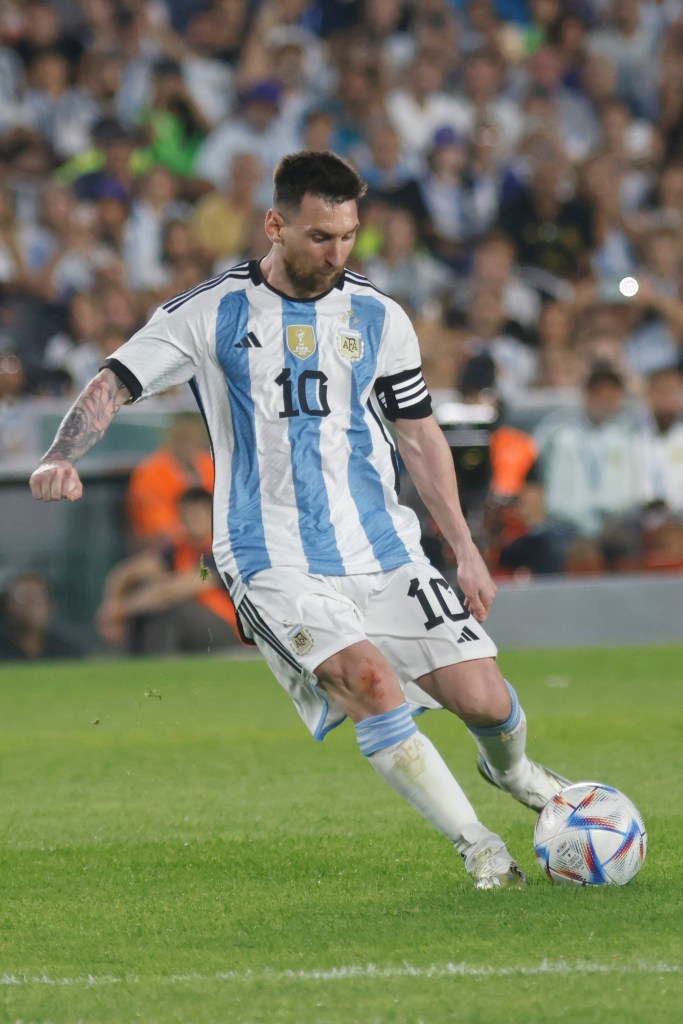
I am a scientist, an ecologist. And I will admit it from the start, I am a fanatic of Lionel Messi since about 2022, a late discovery. And the 2026 World Cup didn’t help. And on October 6th , the final international match of Messi didn’t help. I watched it in Arabic on Youtube. Anyway, a goal on a penalty shot looks the same in Arabic. Some say 50 million watched the game, and others say 3.5 billion, which was less than the final World Cup game earlier this year. But still, almost half of the world’s population watching an Argentine friendly game with Benin?
OK, Messi has changed football in the last two decades with his creativity, artistry, «magic», call it what you will. He has won all the trophies, and may win a 9th Ballon d’Or this fall. He has inspired countless young athletes: «The little boy from Rosario…Messi on a million backs, Messi for a million flashbulbs» (Peter Drury). Sports and soccer have tension, violence, create dreams for an entire nation, and soccer is the ultimate accessible sport to play. The World Cup is the ultimate platform of international competitions, more so even than the Olympics.
As a scientist, I wonder, can we not find a Messi for science, who could «transform» science by his or her creativity? This last week the Nobel prizes were given out for chemistry, physics and medicine / physiology, the last for discoveries about optogenetics which is changing how we think about the brain (to Ken Deisseroth, Peter Hegemann, and Georg Nagel). Stanford University put out a very nice video about Dr Deisseroth, his life, including his family, and how he came to his present place in his domain (https://www.facebook.com/reel/1047925654872850). But few people know these veritable stars of science. Why not? I asked several people in my entourage and the answers were aggregated into two main lines of thinking.
- Scientists are not communicators, we are trained to communicate our discoveries to peers; that is our main work and how we achieve high status in academia. Scientific journalists do the work of then translating the science, as a go-between with the public, and they do a great job. Scientists are focused on their research and training other scientists, not on transfer of ideas to the public. So, in other words, we have little or no interest in becoming a scientific Messi.
- News revolves around more basic elements of society than science, that are closer to our psychology. My partner named them: sex, blood and sport (attributed to Harry Cuff, in a film), generally recognized in the media as the triggers that draw us to read an article or watch a video. Science is far from the forefront of these triggers, even though sometimes we talk about each of these individually, or even in pairs, such as gender and sport.
- I suggest a third factor, that I am certainly not the first one to propose, that is how scientists generally present themselves to the public. We present ourselves as objective and detailed-oriented, presenting cold, hard facts. We don’t show our human side.
In the last decades, we saw Messi display emotions ranging from despair at losses with his national team, to anger on the pitch, to the joy of winning a World Cup. We saw how important his family was through everything. It’s as if we got to know him, we saw his vulnerability and his pride of winning, his pride of country. Scientists rarely reveal their human side, as if to project that we don’t have one. It is difficult for me to think of a scientist whose «story» we know, as we know that of Messi, its as if we are sans emotion, sans context.
Is this helpful for science? In his video, Ken Deisseroth mentions that he aims to use some of the Nobel prize money to communicate how one does science to the public, what is the process, how it can be marvelous. Maybe we should question how we present ourselves. Maybe we should write our stories that include what we care about and why, where we come from, some hints of our subjective lives. Maybe we can learn something from sports icons and project our lives as humans, not just as researchers.
(Photo from Shutterstock $)


Leave a Reply